How to lock a record and why you’d want to

Record locking is when you inform Salesforce you want to lock a record for a certain period of time. Your process becomes the only one that can access that record. Any other processes that attempt to access it at the same time receive an error.… Read the rest

How to prevent automatic flow bulkification

How that we’ve covered flow bulkification and flow interviews, we can tie things together. As mentioned, sometimes Salesforce automagically bulkifies flow interviews.

Most of the time, this is a good thing. Sometimes it’s not so good.

For example, imagine a flow that gets and updates a custom setting.… Read the rest

What are flow interviews?

In Salesforce, there are two flow parts: the building part and the execution part. Here are some interesting things to know about the latter.

Each time a flow executes, Salesforce creates an instance of the flow. The instance is a standalone unique copy of the flow, running within a specific context.… Read the rest

What is flow bulkification?

Most good Salesforce consultants are already familiar with good flow practices. Things like

  • Don’t create/update/delete records (DML operations) within loops
  • Don’t do multiple gets of the same record or related records
  • Don’t update the triggering record in an after-save flow
  • Etc.
… Read the rest

Recharging your perspective

One great way to reflect on your Salesforce career is to take a break.

It doesn’t need to be something dramatic like a sabbatical or extended vacation. But time away from the keyboard, the community, and the ecosystem can be very helpful.… Read the rest

Reflecting on your Salesforce career and beyond

Every once in a while, it’s important to reflect on your career’s trajectory.

Some questions to ask yourself can be

  • Are you happy as a Salesforce consultant?
  • Are you happy with the current state of Salesforce and where they are heading?
… Read the rest

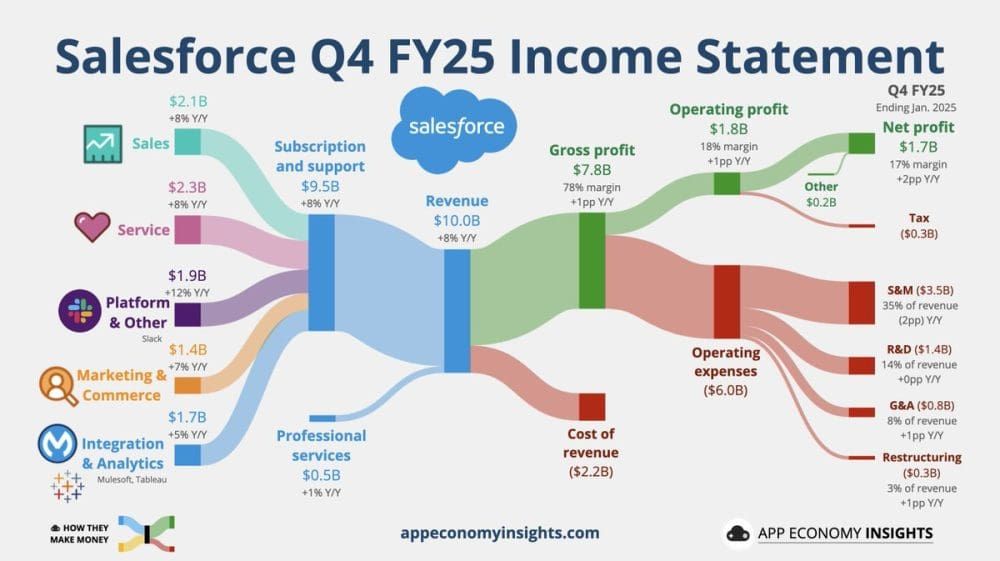
Salesforce’s Q4 2025 observations

Every once in a while, it’s interesting to see how our parent company is doing. You know, the big one that we all depend on for our livelihood.

This income chart was recently released:

It’s interesting to notice a few things:

  1. Service income is greater than Sales.
… Read the rest

UI vs. object: When to require fields

When creating required fields on a standard or custom object, you have two options:

  1. Make them required at the object-level
  2. Make them required at the UI-level

In most cases, the latter is a better option. Why?

When fields are required at an object level, they are *always* required, regardless of the source.… Read the rest

Three options is the sweet spot

Every problem has a solution. Or two. Or three. But did you know that three is actually the best?

Why is that? Well, our brains are naturally wired to respond to three. It’s the smallest number needed to determine a pattern, which makes it naturally appealing.… Read the rest

Formula field considerations

In addition to the spanning relationship limit, there are some other important considerations when using formula fields. There are 3 more:

1. Character limit
Formula fields can have a maximum of 3,900 characters. This includes spaces, carriage returns, and comments.

You can easily solve this limit by reducing spaces, or by splitting the formula into sub-formulas.… Read the rest

What is a spanning relationship?

When attempting to update a client’s formula field on an object, I received an uncommon error message. Salesforce complained, “You have reached the maximum number of object references”.

This error is caused by trying to exceed the limit of cross-object references (also known as “spanning relationships”).… Read the rest

Only use the input variable once

When building flows, it’s common to have input and output variables. Whether passing the current record Id to a screen flow or calling an autolaunched subflow, these variables keep things modular.

Here’s a small tip I haven’t seen often: When using an input variable, only use it once.… Read the rest

Mixing business and pleasure

As a Salesforce consultant, it’s not uncommon to become close to your client. After all, you struggle together and you succeed together. So it should come to no surprise that you bond with them.

This closeness may spill into your personal life.… Read the rest

When will AI replace developers?

There’s more and more chatter about AI replacing developers. Mark Zuckerberg talks about it often these days, and even Marc Benioff has made more than a few comments about it.

While it’s hard to predict the near future, I’m pretty sure about the state of AI today.… Read the rest

Flow debugging techniques

There are multiple ways to debug flows in Salesforce.

The debug button
The first option is the most popular. You create the flow and then click “Debug” to see it run. By the way, if your flow has input variables, there’s a way to speed up the debugging process.… Read the rest

Excellent customer service takes a team

Today I visited a hospital for some routine blood tests. Every time I visit, it’s a pleasure. While that may sound odd at first, it’s because of their excellent customer service.

It started with the ease of booking an appointment with a doctor online within a reasonable time frame.… Read the rest

Achieving flow

I bet you think this email will be about Salesforce flows, eh? Well, it’s not. Instead it’s about flow state.

According to Wikipedia, “Flow state theory suggests that when individuals are in a state of flow, they experience deep immersion, focus, and intrinsic motivation in their activities.”… Read the rest

Giving credit where credit is due

No matter how many compliments your client or team gives you, don’t let it get to your head.

A Salesforce consultant doesn’t usually work alone. They are typically surrounded by abled people, aligned with the same vision as you: be successful.… Read the rest

Nurturing client relationships for long-term success

A client of mine was recently at a crossroads.

As their Salesforce provider, our team recommended they start with a simple MVP. The first release would be a couple of small wins, and be for their employees.

Some of the staff of the client wanted to replace five of their existing web portals.… Read the rest

Saying thank you

Yesterday, during a discovery session, my client demoed their existing five web portals.

The goal of the meeting was to understand the client’s current state. In the near future, I will  estimate the amount of work needed to replicate the portal’s data model, functionality, and security in Salesforce.… Read the rest

A simple hack to building authority

As a Salesforce consultant, one of your roles when interacting with clients is to exude confidence. They need to feel you’re in control of the technical parts of the project, and to deliver a successful project.

It’s always better to build this type of authority in the early stages of client interaction, as first impressions really count.… Read the rest

Buy vs build

A Salesforce client of yours has a problem, so they reached out to you for help.

They’ve explained the issue, you’ve repeated it back to them to confirm your understanding, and now it’s time to make a decision. Also let’s remove urgency from this scenario, as that would clearly encourage you in one direction.… Read the rest

A digital nomad in Spain

It’s been a while since I spoke about being a digital nomad. I used to share this passion almost every Friday, so it’s time for one now.

For the last 4 years, I spent summers in Montreal, Canada and winters in Malaga, Spain.… Read the rest

Using the repeater component in flows

The repeater component is a relatively new feature in screen flows.

A simple way to show its usefulness is through an example. Let’s imagine there’s a Payment object, which is related to the Opportunity. Rather than have your users click “Add” on the Payment related list, enter some data, and then click “Save & New”, you can offer an optimized screen flow with a repeater.… Read the rest

More ways to avoid race conditions within flows

Here are three other mechanisms to avoid race conditions in flows.

1. Add a wait element
Place a wait element after an update, create or delete element. The wait time can be as short as 1 minute, but this ends the current transaction and commits (saves) the operations to the database.… Read the rest

How to setup platform events, with an example

There are a few articles about how to create platform events in Salesforce, but most of them have lots of fluff and unnecessary details. So here’s a concise version.

We’ll use the Nonprofit Success Pack (NPSP) example, in which a household account is created when a contact is created.… Read the rest

When to use platform events

In response to Friday’s email regarding race conditions, a fellow reader suggested using platform events.

This is another great option, if you know how to use them.

If you don’t, here’s a quick synopsis:

When things happen in Salesforce, you may or may not be aware of it.… Read the rest

Avoiding race conditions in flow

A race condition is when multiple transactions are happening at more or less the same time, and they conflict.

Let’s say both transaction A and B look to see if a record exists. If it doesn’t, they create it. Now if A and B happen virtually simultaneously, they both create records and therefore cause duplicates.… Read the rest